ECCV 2026 · eXCV
Sep 8, 2026
3rd Workshop on Explainable Computer Vision
Challenges and Opportunities in the Era of Foundation Models.



ECCV 2026 Workshops
Confirmed ECCV 2026 workshop acceptances: eXCV, MUCG, and UniWorld.
Challenges and Opportunities in the Era of Foundation Models.
DoCoG appears as accepted paper #24.
DoCoG appears as accepted paper #16, with all accepted papers presented as posters.
Paper
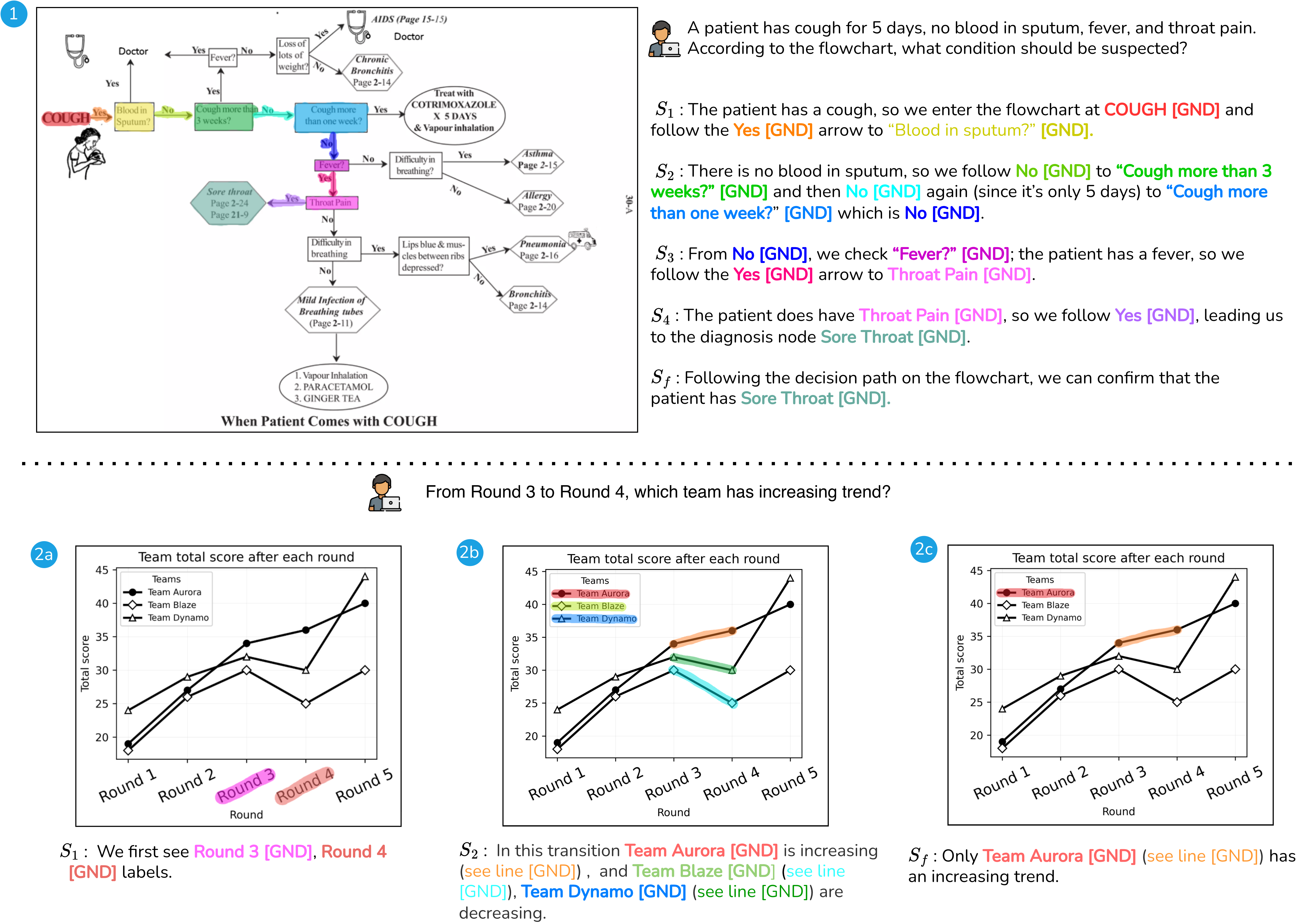
Existing methods for Visual Document Question Answering (DocVQA) often predict answers without explicit intermediate analysis or produce ungrounded intermediate steps. The few approaches which employ grounding produce rectangular bounding boxes which fail to accurately represent complex structures such as pie-chart wedges, flowchart nodes, and curved text. We present DoCoG, a mask-based multi-type grounded step-wise Chain-of-Thought architecture for Document QA.
The model supports multi-type grounding — it localizes both textual content and fine-grained graphical elements such as legends, pie slices, and flowchart nodes. It generates step-wise intermediate outputs and final answers grounded through precise segmentation masks. DoCoG integrates a Vision-Language Model with a promptable segmenter via a novel Grounding Interaction Module (GIM). During decoding, special [GND] tokens trigger mask prediction, linking each step and the final answer to supporting evidence.
We introduce DoCoG-QA, a large-scale diverse dataset comprising 325K documents and 1.5M step-wise grounded QA pairs. We further release DoCoG-PQA with 20K preference pairs for DPO alignment, and DoCoG-Bench, a human-verified benchmark. Experiments show that DoCoG achieves state-of-the-art performance across multiple benchmarks, improving both answer accuracy and grounding precision.
Architecture
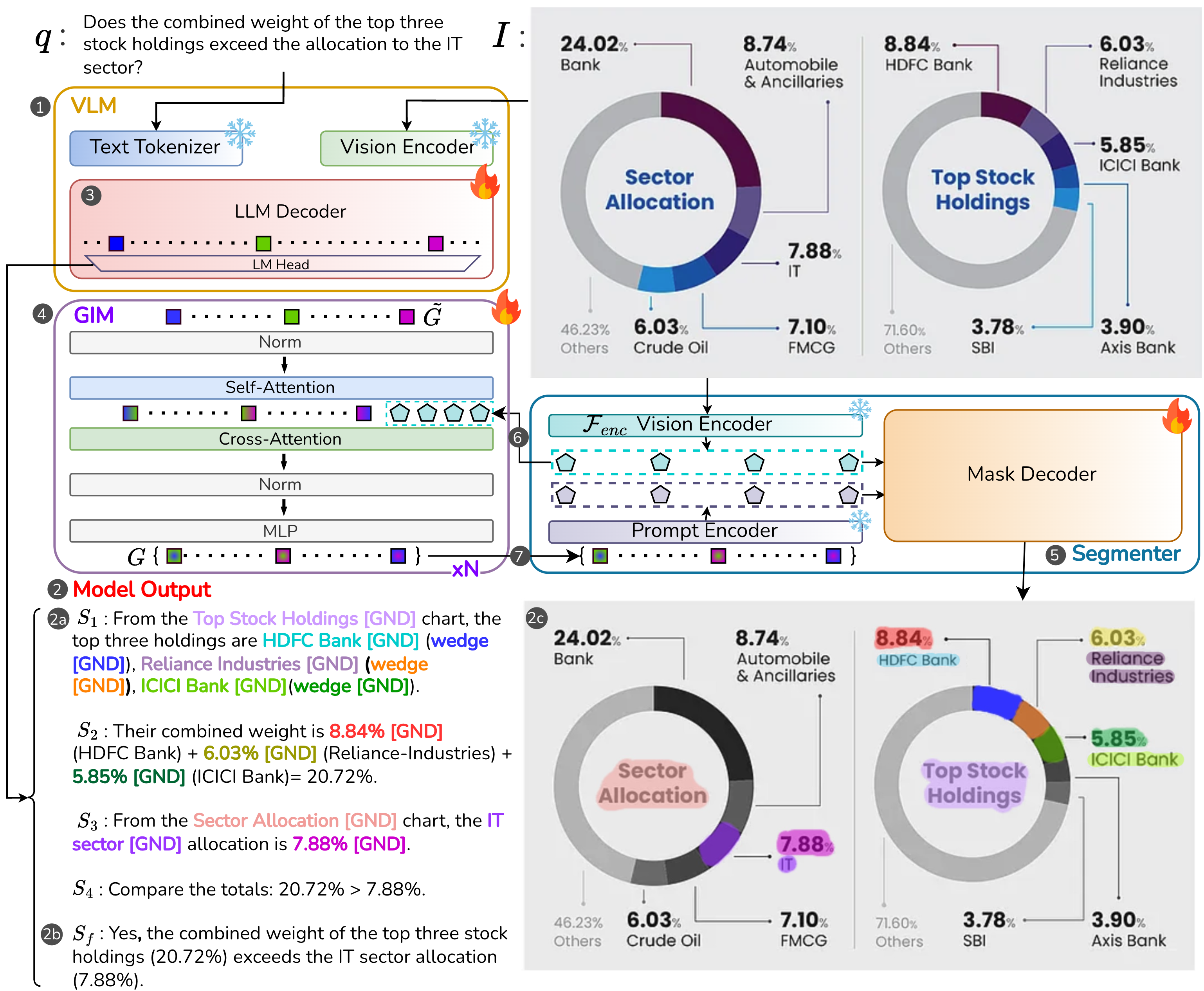
DoCoG architecture: Given a document image \(I\) and question \(q\), the VLM 1 encodes visual features and autoregressively generates step-wise outputs interleaved with [GND] tokens 2. Their hidden states 3 pass to GIM 4, which refines them via cross-attention with segmenter features 6 from 5, producing prompt embeddings decoded into evidence masks (2c).
DoCoG decouples language modeling from spatial prediction. The VLM focuses on step-wise reasoning, while a dedicated segmentation module handles fine-grained, geometry-aware mask localization — yielding cleaner text outputs and more precise evidence masks.
GIM refines [GND] token embeddings through self-attention and cross-attention with visual features from the segmenter. This ensures grounding tokens remain mutually consistent and spatially aligned with the correct document regions.
Press play to watch the forward pass unfold — tokens flow from the VLM through the Grounding Interaction Module into the segmenter, and each [GND] token lands as an evidence mask on the document.
Drag to pan, scroll to zoom · Open fullscreen
DoCoG generates intermediate reasoning steps and final answers, each grounded to supporting evidence spanning textual and graphical elements.
Words, lines, paragraphs, table cells, headers, and form fields
Chart bars, lines, pie slices, legends, axis labels, and plot marks
Flowchart nodes, connectors, arrows, and diagram components
[GND] tokens grounds each reasoning step to pixel-accurate evidence masksModel outputs across charts, flowcharts, tables, and documents — each reasoning step grounded to pixel-level evidence.
Step through DoCoG's grounded reasoning — each [GND] token sweeps a mask over the supporting evidence in the image.
DoCoG is trained in two stages: SFT on DoCoG-QA, then DPO on DoCoG-PQA.
𝓛total = λlm𝓛lm + λseg𝓛seg + λanchor𝓛anchor
Cross-entropy over all output tokens for accurate step-wise CoT generation and answer prediction.
Supervises mask predictions against pixel-level ground truth for each [GND] token.
Preserves [GND] token compatibility with the frozen segmenter during DPO, preventing mask degradation.
Trained on DoCoG-PQA (20K pairs) to align step quality, answer accuracy, and grounding fidelity jointly.
Data
Large-scale training dataset with step-wise grounded Chain-of-Thought, built through a unified data engine across diverse document types with pixel-level mask supervision.
Human-verified benchmark for jointly evaluating answer accuracy, step-wise CoT quality, and mask-level grounding fidelity across diverse document types.
20K preference pairs for Direct Preference Optimization (DPO), constructed using a reward function combining AQ, CQ, and GQ scores to select chosen/rejected samples for alignment training.
Evaluation
DoCoG consistently outperforms both commercial and open-source baselines. While commercial models achieve competitive answer accuracy, their grounding quality remains substantially lower.
Hover bars for score · Sorted by performance (high → low)
AQ and GQfa per split. "All" reports AQ, Geval, CQ, GQall, and GQfa.
| Model | Params | Charts | Flowcharts | Docs | Tables | All | ||||||||
|---|---|---|---|---|---|---|---|---|---|---|---|---|---|---|
| AQ | GQfa | AQ | GQfa | AQ | GQfa | AQ | GQfa | AQ | Geval | CQ | GQall | GQfa | ||
| GPT-5 | – | 82.4 | 3.8 | 78.1 | 4.0 | 86.7 | 5.0 | 84.3 | 6.4 | 82.9 | 84.8 | 76.8 | 2.4 | 4.8 |
| Sonnet 4.5 | – | 79.1 | 5.7 | 75.3 | 13.3 | 83.8 | 6.8 | 81.6 | 2.6 | 79.9 | 80.5 | 71.3 | 3.3 | 7.1 |
| Gemini 3 Pro | – | 83.2 | 11.2 | 79.4 | 10.1 | 88.1 | 11.7 | 86.0 | 12.6 | 84.2 | 84.1 | 75.2 | 15.4 | 11.4 |
| Gemini 3 Flash | – | 79.6 | 12.7 | 75.8 | 12.5 | 84.5 | 35.3 | 82.4 | 33.9 | 80.6 | 82.8 | 73.4 | 32.8 | 23.6 |
| InternVL 3.5 | 8B | 73.4 | 4.1 | 67.2 | 1.5 | 77.1 | 7.2 | 78.0 | 3.2 | 73.9 | 78.2 | 33.2 | 2.9 | 4.0 |
| Qwen3-VL | 8B | 75.2 | 3.9 | 69.4 | 11.0 | 78.6 | 6.3 | 79.5 | 0.9 | 75.7 | 77.6 | 35.9 | 3.5 | 5.5 |
| VisualCoT | 7B | 52.3 | 5.5 | 44.6 | 3.9 | 59.7 | 3.6 | 55.4 | 1.0 | 53.0 | 52.1 | 51.2 | 2.4 | 3.5 |
| InternVL 3.5 FT | 8B | 74.6 | 65.0 | 68.8 | 67.9 | 82.0 | 64.3 | 79.1 | 61.2 | 76.1 | 80.4 | 72.2 | 61.4 | 64.6 |
| Qwen3-VL FT | 8B | 75.8 | 63.9 | 70.2 | 66.9 | 83.4 | 61.2 | 80.6 | 55.6 | 77.5 | 79.8 | 74.8 | 57.8 | 61.9 |
| DoCoG (Ours) | 9B | 83.5 | 80.3 | 82.2 | 79.2 | 89.7 | 85.4 | 87.8 | 82.7 | 85.8 | 85.2 | 82.0 | 78.2 | 81.9SOTA |
Click the metric pills to switch charts. Each domain card shows detailed per-benchmark breakdowns.
Hover for score · sorted high → low
| Model | ChartQA | CQA-Pro | ChartBench | CharXiv | Bench AQ |
|---|---|---|---|---|---|
| GPT-5 | 89.0 | 42.7 | 69.4 | 76.3 | 82.4 |
| Chart-R1 | 91.0 | 44.0 | 34.1 | 46.2 | 74.2 |
| InternVL 3.5 | 86.7 | 34.7 | 51.4 | 68.8 | 73.4 |
| Qwen3-VL | 89.6 | 32.9 | 65.3 | 64.7 | 75.2 |
| DoCoG | 92.7 | 52.1 | 79.4 | 73.1 | 83.5 |
Hover for score · sorted high → low
| Model | FlowVQA | AI2D | MISS-QA | Bench AQ | Bench GQfa |
|---|---|---|---|---|---|
| GPT-5 | 91.9 | 89.5 | 71.7 | 78.1 | 4.0 |
| InternVL 3.5 | 78.4 | 84.0 | 48.5 | 67.2 | 1.5 |
| Qwen3-VL | 81.0 | 85.7 | 46.2 | 69.4 | 11.0 |
| DoCoG | 85.5 | 88.3 | 78.4 | 82.2 | 79.2 |
Hover for score · sorted high → low
| Model | TabFact | WTQ | TabMWP | Bench AQ | Bench GQfa |
|---|---|---|---|---|---|
| GPT-5 | 87.7 | 78.8 | 93.7 | 84.3 | 6.4 |
| InternVL 3.5 | 78.1 | 55.6 | 55.7 | 78.0 | 3.2 |
| Qwen3-VL | 81.8 | 57.4 | 65.6 | 79.5 | 0.9 |
| DoCoG | 89.4 | 64.4 | 80.7 | 87.8 | 82.7 |
Hover for score · sorted high → low
| Model | DOGR F1g | MMDB IoU | VCoT | BD F1g | Bench AQ |
|---|---|---|---|---|---|
| GPT-5 | 3.6 | 9.3 | 89.7 | 5.4 | 86.7 |
| Gemini 3 Pro | 65.3 | 55.4 | 87.4 | 73.5 | 88.1 |
| Qwen3-VL | 27.6 | 28.7 | 86.7 | 44.5 | 78.6 |
| DoCoG | 75.4 | 70.5 | 88.9 | 85.4 | 89.7 |
Citation
If you find our work useful in your research, please consider citing:
@inproceedings{gunda2026docog,
  title={DoCoG: Mask-Based Multi-type Grounded Chain-of-Thought for Document QA},
  author={Gunda, Sai Madhusudan and Jinka, Jyothi Swaroopa and Rachakonda, Hrithik Sagar and Jain, Aryan and Venna, Venkata Kesav and Srinivasan, Anirudh and Sarvadevabhatla, Ravi Kiran},
  booktitle={European Conference on Computer Vision},
  pages={308--327},
  year={2026},
  organization={Springer}
}